
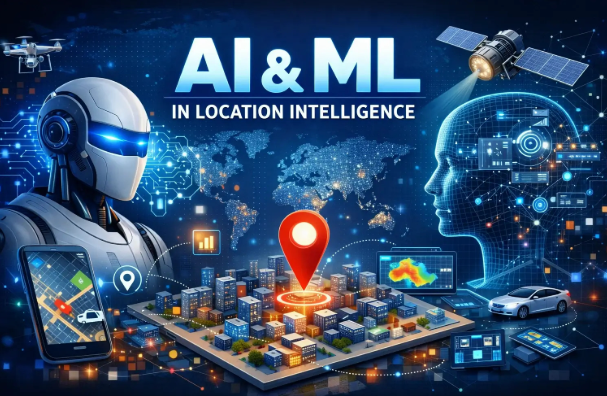
AI and ML in Location Intelligence
Location data is essential to how today's organizations make business decisions. Each time someone uses their smartphone and GPS, each time an online order is tracked during delivery, and each time customers use search engines or apps to find local products or services, significant amounts of location data are generated.
Raw data generated by the location services cannot be said to be valid until it has been cleaned (or analysed) to derive meaningful information. Location intelligence is played out there.
Location intelligence involves gathering, studying and visualising data through geographic and spatial data by applying different methods. Location intelligence can be even more powerful when it is combined with AI and machine learning (ML) to provide users with accurate and actionable information that can be used to better leverage their data.
Using AI and ML, organisations across the globe are turning to these technologies to create location-intelligence solutions that can be used in business operations to increase profitability and the customer experience. The knowledge derived through AI and ML is already being applied by retail planners, urban planners, and city traffic engineers in order to become more skilled at handling location data.
This blog post provides an in-depth overview of how AI and ML support the power of location intelligence, how organisations are leveraging AI-based location intelligence, examples of how AI is being used in location intelligence, the limitations and challenges associated with AI, and trends in the future of AI-based location intelligence.
What is Location Intelligence?
Location intelligence refers to the process of collecting, analyzing, and presenting geographical data in order to know where things or people are, how they move as well as why things are occurring in specific locations. Information in this data is available in a wide range of input sources including; GPS units, cellular phones, satellite imagery, sensors and other sources of geographic information like maps and GIS. The purpose of the analytical process eventually creates the insights that will lead to better planning and decision making.
Location Intelligence was traditionally dependent on static map views, with humans manually determining where data/responses would fall. Although this method was helpful, it could not handle large amounts of complex information, e.g., hundreds of thousands of data points, on a permanent basis.
However, thanks to technological advancements in AI (Artificial Intelligence) and ML (Machine Learning), Location Intelligence is now more efficient, intelligent, and accurate than ever before.
Role of AI and ML in Location Intelligence
AI and ML significantly improve Location Intelligence.
Using AI, we can analyze vast amounts of spatial data and draw conclusions based on logic, just as a person would. Using ML, we continually leverage historical location data to improve accuracy.
Both AI and ML enable us to find patterns in the Location Intelligence that we would not be able to see through manual analysis. Examples include Traffic congestion patterns, Customer movement patterns, and Crime Hotspot identification. Using ML models, we can now perform Predictive Analysis to forecast future events based on historical location data.
Another significant advantage of using AI and ML with the Location Intelligence systems is Automation! Through AI, Location Intelligence companies can perform data processing and cleaning, mapping, and gain insight from raw data without the need for human intervention. It saves time and minimizes mistakes.
By integrating AI and ML with the Location Intelligence systems, we develop from Descriptive Analysis to Predictive and Prescriptive Decision-Making.
How AI & ML Enhance Location Intelligence?
AI and ML significantly improve location intelligence by enabling faster, more accurate analysis. One significant enhancement is pattern recognition. Machine learning can analyse millions of data points to recognise patterns in space, such as heavily populated areas and areas where people frequently have accidents.
AI can predict future customer behaviour based on past behaviour. An example of this is that AI can use past location information to predict future demand, traffic flow, and population growth. By providing forecast data, businesses and government agencies can make informed decisions, reducing risk and improving planning.
The processing of location data in real time would support applications such as ride-sharing services, delivery tracking, and emergency response systems. These systems would use real-time data to make on-the-spot decisions based on current events.
Additionally, AI would help make repetitive processes more efficient by automating data validation and detecting unusual activity. AI and machine learning can help turn location intelligence from simple mapping tools into powerful decision-support tools for organisations of all types and sizes.
How Different Industries Use AI & ML To Make More Efficient Use of Location Intelligence?
The AI- and ML-based location intelligence systems are applied in various sectors today in order to enhance efficiency. Location intelligence helps retailers to find the most favorable places to open their stores, develop more specific advertising activities, and to improve inventory management.
It is being used by logistics companies to streamline delivery routes, save fuel and also to monitor their vehicles in real-time. Location intelligence is helping smart cities to track traffic, environmental conditions (including pollution), and services provided to the population.
It is being used by healthcare organisations to track the disease outbreaks, plan the most efficient ambulance paths, and determine the underserved regions. The financial services industry is currently engaging location intelligence to identify possible fraud based on the unusual transactions in a particular location/region. It is one of the ways through which real estate companies are analysing trends of their neighbourhoods to assess the value of property and investment prospects.
The relationship between businesses and location data is being transformed by AI and MLs that can transform it into usable information that can assist businesses to become more productive, minimize costs, and deliver a better experience to customers and communities by being aware of location behavior.
What Are The Benefits of AI & ML in Location Intelligence?
The use of AI and ML will allow location intelligence users to decide faster. The use of information will eliminate confusions in decision-making and provide location intelligence users with the assurance of making informed and timely decisions. Predictive analysis will also allow businesses to determine the trends in the future based on location data and change their strategies accordingly.
The optimisation of routes and site selection will bring about cost saving, and the efficiency in the allocation of resources. Manual and repetitive tasks will also increase productivity as AI and ML will automate processes.
The ability to have an AI-enabled location intelligence platform provides organizations with a competitive advantage because it allows more comprehension of their markets and allows them to respond to changes faster. Also, the businesses can be scaled, because the location intelligence platforms based on AI are designed to operate with large volumes of data.
The second way AI and machine learning are applied to the location intelligence of organizations is the enhancement of the customer experience due to location-based and personalized services. Consequently, organizations will enhance customer satisfaction hence increased loyalty in the long run.
What Are The Challenges and Limitations of AI & ML in Location Intelligence?
The application of AI and machine learning in the location intelligence area has substantial challenges and restrictions. Data security and privacy is one of the challenges that are very important. Location information might be confidential and its misuse could lead to the infringement of privacy of an individual. Companies employing location data should guarantee that relevant data privacy and protection laws are followed and act in accordance with the ethical standards.
Another challenge is data quality. AI-enabled models require access to accurate, timely data to deliver high-quality BI and insights—not poor-quality data. Multi-source data integration is a complex and challenging problem area. Implementation costs are an obstacle to overcome for small organizations.
AI technologies require advanced infrastructure to operate and require increased investment in skilled personnel, as well as continued maintenance of both software and hardware. Therefore, organizations also need the knowledge and ability to interpret AI-generated insights to prevent misuse or misinterpretation.
What Are The Future Trends in AI & ML for Location Intelligence?
The future looks very bright for the use of AI and ML in location intelligence. The leading trend is the rise of real-time location intelligence, which will improve users' ability to make better decisions more quickly. Significant improvements to smart cities, transportation systems, and emergency operations will be possible with this new level of intelligence.
Another leading trend in the future of AI & ML Location Intelligence is the invention of digital twins, virtually created models that simulate a real-world environment. The ability to take AI-generated location data and use it to create simulated models of reality will enable organizations to simulate and predict real-world scenarios.
As the Internet of Things (IoT) and Edge Computing Technologies mature, Organizations will benefit from having Access to Real-Time Location Intelligence data. Processing this data closer to the actual point of origin (IoT) will reduce latency and increase the accuracy of the processed information.
AI and ML location intelligence systems within an organization will also create more personalized customer experiences. Organizations will do more with AI and ML, but this will also result in increased emphasis on ethical use of AI, transparent governance, and the protection of customer privacy. All of these trends will lead to the next generation of intelligent location-aware systems.
Conclusion
The future of location intelligence is being recreated by AI and ML. AI and ML are helping organizations make better decisions by transforming raw Geographic information into actual, usable, predictive and actionable Insights. The location intelligence based on AI and ML will result in efficiencies, innovations, and expansion opportunities in every industry, ranging to Retailing and Logistics to Healthcare and Urban Development.
Even though there are numerous challenges (including the issue of privacy of the data), the positive aspects of using AI and ML as a means of location intelligence far outweigh the drawbacks. The main thing that any organization can achieve a maximum utility of applying AI and ML to location intelligence will be to use the relevant technologies and elaborate a functional plan to apply the technology and regulate them.



0 Comments